A history of the US power grid, in six crises
The Grid Was Not Built for This!
Data centers are coming for the grid, and everyone is worried the grid can't take it. Here is the thing: the grid has never been ready. Not in 1892, not in 1935, not in 1942, 1965, 2000, or 2020. Every time, it came out stronger. This is that story, told with data.
"The grid was not built for this" is an argument I am seeing more of in the wake of impending load growth from data centers. The US grid — touted by many as the largest machine ever built — is actually a pretty disjointed machine. It has so many components bolted onto it that it is nearly indistinguishable from its incipient self, and every one of those band-aids is a scar from a shock the grid has survived. It is not a beautiful engineering artifact designed from the ground up; it is an evolution, with vestiges of the distant past still lingering. Over more than a century, the grid has been declared inadequate again and again — the grid was not built for this! — and every time, we recovered stronger than before.
Before the history lesson, one chart to frame it. US electricity generation grew roughly 15-fold from 1949 to today. Nearly every annotation on this curve marks a moment when serious people declared the grid unfit for what came next. The curve kept climbing anyway.
1882–1907 · Electricity as champagne
A Luxury Product on a Patchwork of Wires
Electricity began as a hyper-local business. Edison's Pearl Street Station opened in Manhattan in September 1882 serving roughly 85 customers — a DC system whose economics collapsed beyond about a mile of copper. These were extremely local, high-cost systems with the unreliability that accompanies any new technology. And yet it was obvious almost immediately that this was a faster, better, more efficient way to move energy. (If you want to see the vestiges of the era it replaced, you can still find capped compressed-air pipes in old city buildings — pneumatic power was a mainstream competitor at the time.) Demand surged, especially from industry. After the War of Currents, Westinghouse's AC triumphed on the strength of efficient long-distance transmission, and for the first time power plants could be located far from the cities they served — the Niagara Falls hydro project sent power 26 miles to Buffalo in 1896 and settled the argument.
But the technical fix didn't solve the economic mess. Dozens of tiny private companies strung competing wires down the same streets — Chicago alone had more than 20 electric companies in 1892 — with no price regulation and constant bankruptcies. Electricity was priced like a luxury: in 1892, a kilowatt-hour cost the equivalent of roughly $9 in today's money, about 45 times what we pay now. As companies went bankrupt and new ones rose from their ashes, you can almost hear the whisper: the grid was not built for this connected world.
In comes Samuel Insull. His insight was economies of scale and, above all, utilization: the same generator serving factories by day, streetcars at rush hour, and homes in the evening spreads its fixed costs across far more kilowatt-hours. Insull consolidated Chicago's chaos into Commonwealth Edison, deliberately recruited large industrial loads to fill the valleys in his load curve, and — remarkably for a monopolist — invited state regulation of his prices in exchange for exclusive franchises. It is not often that the US walks away from competition and deliberately builds regulated monopolies, but the price data that followed suggests it was the right call for the moment. Electricity went from champagne to tap water.
A century later, Insull's utilization argument is being dusted off almost word for word: filling the grid's idle hours with large flexible loads (then aluminum smelters, now data centers) to spread fixed costs and reduce the burden on residential customers. The playbook is older than the interstate highway system — though the metric itself needs an update. Virginia's 2024 grid-utilization law scores flexible loads against fixed rated capacity, which quietly rewards firm gas and punishes variable solar and wind. In a grid utilization factor built for a renewables-heavy grid, I argue the denominator should be hourly available capacity instead — so a data center gets credit for shifting load to when the sun is actually out, not just for running around the clock.
The consolidation era ended in its own crisis, worth a footnote because it shaped everything after: by the late 1920s, unregulated holding companies had pyramided utilities into leveraged financial towers — a handful of them controlled most of US electricity — and cared more about financial engineering than building transmission. The 1929 crash brought the whole structure down (Insull's own empire included), wiping out millions of small investors. The response — the Public Utility Holding Company Act and the Federal Power Act of 1935 — broke up the pyramids and gave the federal government jurisdiction over interstate power. The grid's finances, like its wires, got rebuilt stronger after the failure.
1930–1950 · Half of America in the dark
The Grid That Stopped at the City Limits
By the mid-1930s America had a huge rift in electrification. Urban America was electric — 85% of non-farm households had power by 1930. Rural America was not: fewer than 10% of farms had electricity that same year. Private utilities couldn't recoup the cost of stringing miles of line for a handful of far-flung customers, so they simply didn't. Electrification was the tool of prosperity and productivity, and denying it to a third of the country meant America was not moving forward together. Once again: the grid was not built for this.
FDR's New Deal answered with the Rural Electrification Administration (1935 executive order, 1936 Act): low-interest loans to farmer-owned cooperatives — not private utilities — plus standardized engineering and wiring programs that slashed construction costs. The cooperatives built the lines themselves. The curve below is one of the fastest infrastructure catch-ups in American history.
The payoff compounded for decades: electric pumps, milking machines, refrigeration, and lighting transformed farm productivity, and the cooperative model built then still serves some 42 million Americans today. A grid that "couldn't" serve rural America ended up defined by it.
1941–1945 · The war load
World War II: A Data-Center Boom in Sepia
If you want a historical rhyme for AI load growth, this is it. During World War II the country needed an industrial on-ramp no one had planned for. Aluminum and magnesium smelting for aircraft came to consume about one-seventh of all US electricity. Oak Ridge — the Manhattan Project's uranium enrichment complex — was stood up in barely a year and a half and at full tilt drew more power than New York City. Sound familiar? Giant, secretive, energy-hungry facilities built at breakneck speed for a technology race with existential stakes.
Read those first two tiles again: consumption grew 60% while capacity grew only 25%. The gap was closed by wiring existing regional grids together and squeezing more hours out of every installed kilowatt — utilization, again. The wartime interconnections became the skeleton of the modern Eastern and Western Interconnections, a build-out later reinforced by Cold War security planners who wanted power to be "wheelable" across regions if any one plant was lost. The grid absolutely was not built for a 60% demand shock. It absorbed one anyway, and kept the transmission afterward.
1965–2005 · The blackout era
When Interconnection Bit Back
Postwar interconnection made power cheaper and more reliable — until it didn't. A grid stitched together from regional systems meant a single bottleneck could now take down a multi-state region. On November 9, 1965, one incorrectly set protective relay at a Niagara-area plant tripped, power sloshed catastrophically through the Northeast, and 30 million people across 80,000 square miles lost power for up to 13 hours. The vulnerabilities of the machine were suddenly on the front page of every newspaper. The grid was not built for this.
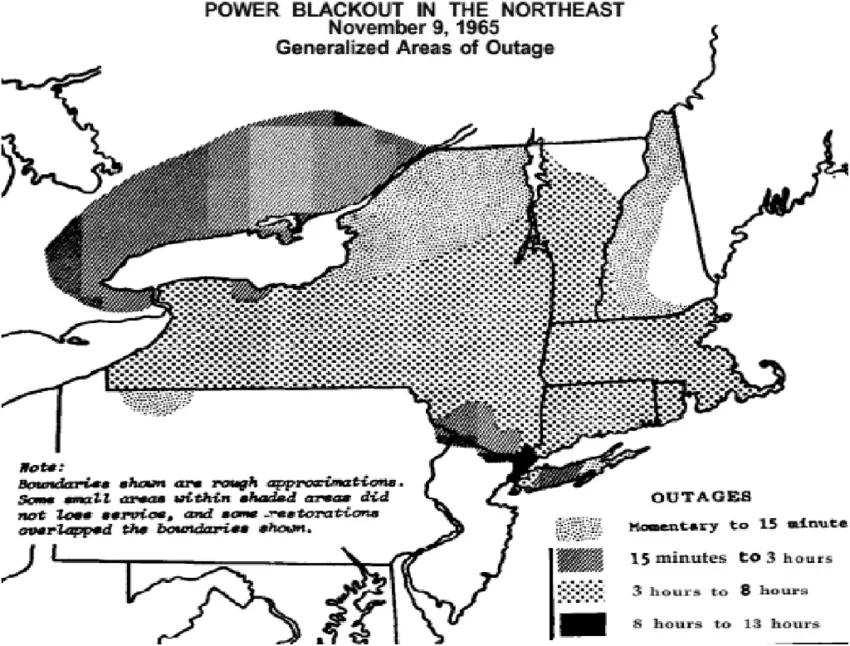
The response was institutional rather than physical: utilities formed regional reliability councils and, in 1968, NERC — a voluntary body writing shared operating standards, coordination protocols, and best practices for a machine that no single company owned. It largely worked, but "voluntary" got its stress test on August 14, 2003, when a control-room alarm failure and some untrimmed trees in Ohio cascaded into a blackout affecting 50 million people in the US and Canada, at an estimated cost of $4–10 billion. Two years later the Energy Policy Act of 2005 made NERC's standards mandatory and enforceable, with million-dollar-per-day fines. Each blackout bolted new discipline onto the machine: the 1965 event gave the grid its rulebook, and 2003 gave the rulebook teeth. Wide-area cascading blackouts of that class have not recurred in the two decades since.
1973–2001 · Price shocks and the market experiment
The Cheap-Power Machine Breaks, Then Reinvents Itself
For its first 80 years the grid had one core promise: every year, cheaper. Then the 1970s happened. Oil shocks (electricity prices jumped 18% in 1974 alone), inflation, and staggering nuclear cost overruns broke the declining-cost model. The policy response — PURPA in 1978, the Energy Policy Act of 1992, and FERC Order 888 in 1996 — pried the grid open, forcing utilities' transmission lines to carry competitors' power. A grid built on vertical integration, with big central plants radiating power outward to captive customers, suddenly had to move power back and forth between distant strangers. The grid was not built for this.
And, for a while, it genuinely wasn't. California's flawed market design met a drought and market manipulation in 2000–2001, and the result was the mother of all market failures.
The crisis was brutal — roughly 3.5% of California's annual economic output in added energy costs — but look at what got built out of the wreckage: organized markets run by independent system operators, transparent day-ahead and real-time prices, market-power monitoring, and resource-adequacy rules. Those institutions are precisely the machinery that today dispatches power across regions like a seamless machine (albeit with plenty of seams), and the price signals they publish are what make batteries, demand response, and every other modern grid innovation investable. The failed experiment became the operating system.
Meanwhile, the long price story quietly resolved itself. Since 1978, the nominal price of electricity has roughly quadrupled — but adjusted for inflation, electricity is cheaper today than it was in 1978, and 26% below its 1984 peak.
2013–2026 · Too much of a good thing
The Solar Glut and the EV "Apocalypse"
The renewables era earned the same cry from the advocates of conventional generation. Utility-scale solar and wind aren't centrally located; they sit far from load, they need new transmission, and at midday they produce a glut of near-zero-marginal-cost power. Markets were shocked — literally: CAISO real-time prices plunged as low as -$150/MWh during the worst of the solar floods, and curtailment climbed year after year. The grid was not built for this.
Then batteries showed up, drawn by exactly those price signals. The result is one of my favorite recent findings (explored in my duck curve deep-dive): curtailment and negative prices are de-linking. Spring curtailment jumped to a record 3,683 GWh in 2026, up 75% from 2025 — more clean energy than the grid could use went unused than ever before. Yet market pain went the other direction: the median negative price compressed from -$17.8/MWh in 2024 to -$8.0/MWh in 2026, and total economic exposure to negative prices fell by more than half, from $262M to $103M. More curtailment, less pain.
The EV story is even cleaner. California pushed EV adoption hard, and reputable outlets published pieces explaining how mainstream EVs would break the grid — the phrase "grid collapse" did the rounds. In August 2020, with well under a million EVs on the road, California did suffer rolling blackouts (a supply-planning failure, not an EV one) and the doomsayers felt vindicated. What actually happened next: the state tripled its EV fleet to over 2.5 million while the grid recorded its most reliable stretch in years — zero Flex Alerts in 2023, 2024, and 2025, through record-setting heat waves.
What fixed it wasn't luck; it was the crisis doing its usual work. The 2020 blackouts triggered a storage build-out that took California from ~0.5 GW of batteries to more than 15 GW, smart-charging programs that shifted EV load into the solar belly of the day, and tightened resource adequacy rules. EVs are now on track to become grid assets, with vehicle-to-grid pilots turning millions of parked cars into distributed storage. The load that was supposed to break the grid is becoming part of its resilience.
2023–? · Today's crisis: The AI load boom
So, About Those Data Centers
Today we are at another such junction, and the sirens are the loudest they've been in my lifetime. US electricity demand barely moved for two decades — and the muscle memory for growth atrophied with it. Now data centers, EVs, heat pumps, and re-industrialization are stacking demand on the grid simultaneously. The numbers being thrown around are genuinely wild:
A queue holding twice the nation's installed capacity, wait times near five years, hyperscalers threatening to go off-grid entirely. If any moment deserves the refrain, it's this one: the grid was not built for this.
Correct. It never was. That's the whole point of this essay.
It wasn't built for the connected city, so Insull rebuilt its economics. It wasn't built for rural America, so the New Deal rewired its footprint. It wasn't built for a 60% wartime demand shock, so we interconnected it. It wasn't built for cascading failures, so we gave it a rulebook — then gave the rulebook teeth. It wasn't built for open markets, so we redesigned them mid-flight. It wasn't built for solar gluts and millions of EVs, and batteries turned both from threats into assets. Every generation inherits a grid built for the previous generation's problems, declares it inadequate, and rebuilds it. The band-aids are the machine.
And the receipts from that process are extraordinary. Here is the same product — one kilowatt-hour, delivered to an American home — priced across 134 years of crises:
Why am I optimistic this time? Partly because the crisis is already doing its usual work: interconnection reform is moving faster than it has in decades, transmission is getting built, and load flexibility — Insull's century-old trick — is being rediscovered as the cheapest resource on the system. An optimistic outcome would be a policy framework built for growth: a revamped queue that prioritizes viable projects and lets flexible loads and generators connect before every peak-hour upgrade is complete, rather than leaving them stuck for years behind speculative requests. But mostly because of what the capital wave makes possible. The solar+battery run has been spectacular, but the next rung on the clean-firm ladder — enhanced geothermal, advanced nuclear — has been waiting for a customer willing to fund the leap down the learning curve. Data centers, desperate for clean firm power at any reasonable price, are that customer. These technologies needed a push, and this may well be their moment to shine. We'll find out at the end of this crisis whether they clear the bar — but the field is wide open again for what comes after solar+battery, and that is exactly how every previous chapter of this story started.